
Editorial activities Home Research Books Published Publications Events Editorial Activities

Surfaces and Interfaces Define Reality

...at every scale

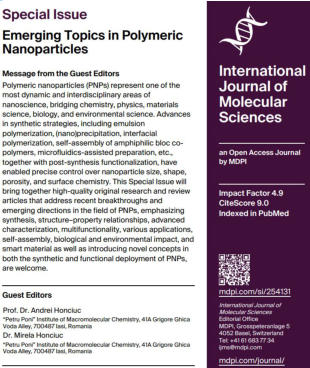
Emerging Topics in Polymeric Nanoparticles (first edition 2026) Together with Dr. Mirela Honciuc I am organizing Special Issue in International Journal of Molecular Sciences. This Special Issue is dedicated to polymeric nanoparticles (PNPs) that represent one of the most dynamic and interdisciplinary areas of nanoscience, bridging chemistry, physics, materials science, biology, and environmental science. Advances in synthetic strategies, including emulsion polymerization, (nano)precipitation, interfacial polymerization, self-assembly of amphiphilic block co-polymers, microfluidics-assisted preparation, etc., together with post-synthesis functionalization, have enabled precise control over nanoparticle size, shape, porosity, and surface chemistry. Sustained research efforts over the past few decades have paid off, leading to PNPs with varied advanced functionalities, including stimuli responsiveness, directional motion, triggered adsorption and cargo release, and the ability to self-assemble into reconfigurable suprastructures. The PNPs are now being deployed in increasingly more complex applications, such as drug delivery, diagnostic imaging, biosensing, catalysis, water purification, or optoelectronics. Beyond their technological potential, PNPs are increasingly scrutinized for their environmental footprint, particularly regarding microplastic generation, persistence in aquatic and terrestrial ecosystems, and bioaccumulation. Understanding the life cycles of PNPs, from synthesis to use to degradation, as well as their interaction with humans and environments, is essential to ensure their responsible and safe development. You are cordially invited to submitt your work. Submission deadline 30 April 2026
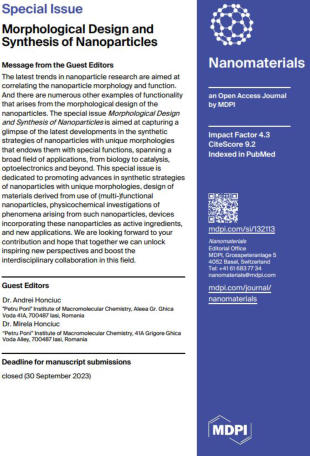
Morphological Design and Synthesis of Nanoparticles (first edition 2024) Together with Dr. Mirela Honciuc I am organizing Special Issue in Nanomaterials. The latest trends in nanoparticle research are aimed at correlating the nanoparticle morphology and function. For example, the asymmetry of Janus nanoparticles endows these amphiphilic properties, and capability to partition at interfaces, self-assemble into suprastructures, emulsify or function as unidirectional nanomotors, etc. But there are numerous other examples of functionality that arises from the morphological design of the nanoparticles, for example in nanoparticle catalysis, in drug delivery systems, or nanoparticles used as technology enablers for designing nanostructured materials, interfaces and composites. The special issue Morphological Design and Synthesis of Nanoparticles is aimed at capturing a glimpse of the latest developments in the synthetic strategies of nanoparticles with unique morphologies that endows them with special functions, spanning a broad field of applications, from biology to catalysis, optoelectronics and beyond. This special issue is dedicated to promoting advances in synthetic strategies of nanoparticles with unique morphologies, design of materials derived from use of (multi-)functional nanoparticles, physicochemical investigations of phenomena arising from such nanoparticles, devices incorporating these nanoparticles as active ingredients, and new applications. We are looking forward to your contribution and hope that together we can unlock inspiring new perspectives and boost the interdisciplinary collaboration in this field. Submission deadline 30 September 2023. The Special Issue has now been closed, it was a real succes, we thank our colleagues for submitting their great work! The Special Issue contributions have now been published as a BOOK.
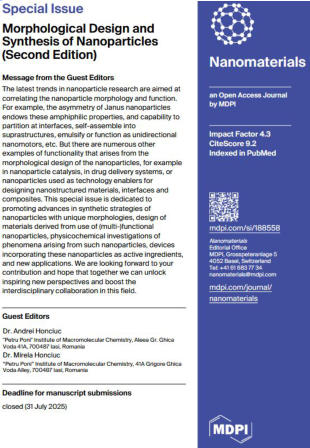
Morphological Design and Synthesis of Nanoparticles (second edition 2025) Together with Dr. Mirela Honciuc I am organizing Special Issue in Nanomaterials to capture the latest trends in nanoparticle research are aimed at correlating the nanoparticle morphology and function. For example, the asymmetry of Janus nanoparticles endows these amphiphilic properties, and capability to partition at interfaces, self-assemble into suprastructures, emulsify or function as unidirectional nanomotors, etc. But there are numerous other examples of functionality that arises from the morphological design of the nanoparticles, for example in nanoparticle catalysis, in drug delivery systems, or nanoparticles used as technology enablers for designing nanostructured materials, interfaces and composites. The special issue Morphological Design and Synthesis of Nanoparticles is aimed at capturing a glimpse of the latest developments in the synthetic strategies of nanoparticles with unique morphologies that endows them with special functions, spanning a broad field of applications, from biology to catalysis, optoelectronics and beyond. This special issue is dedicated to promoting advances in synthetic strategies of nanoparticles with unique morphologies, design of materials derived from use of (multi-)functional nanoparticles, physicochemical investigations of phenomena arising from such nanoparticles, devices incorporating these nanoparticles as active ingredients, and new applications. We are looking forward to your contribution and hope that together we can unlock inspiring new perspectives and boost the interdisciplinary collaboration in this field. Submission deadline 31 July 2025. The Special Issue has now been closed, it was a real succes, we thank our colleagues for submitting their great work!
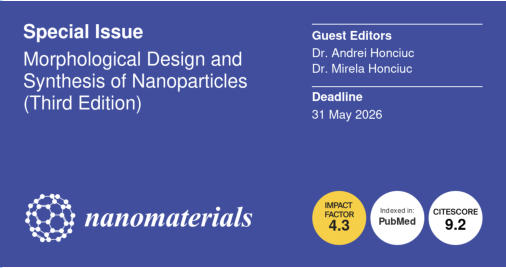
Morphological Design and Synthesis of Nanoparticles (third edition 2026) We, Dr. Mirela Honciuc and I are organizing Special Issue in Nanomaterials aiming to continue tracking the latest trends in nanoparticle research aim to correlate nanoparticle morphology and function. For example, the asymmetry of Janus nanoparticles endows these amphiphilic properties and the capability to partition at interfaces, self-assemble into suprastructures, and emulsify or function as unidirectional nanomotors. But there are numerous other examples of functionality that arise from the morphological design of the nanoparticles; for example, in nanoparticle catalysis, in drug delivery systems, or nanoparticles used as technology enablers for designing nanostructured materials, interfaces, and composites. This Special Issue, entitled “Morphological Design and Synthesis of Nanoparticles (Third Edition)”, aims to capture a glimpse of the latest developments in the synthetic strategies of nanoparticles with unique morphologies that endow them with special functions, spanning a broad field of applications, from biology to catalysis, optoelectronics, and beyond. This Special Issue is dedicated to promoting advances in synthetic strategies of nanoparticles with unique morphologies, design of materials derived from the use of (multi)functional nanoparticles, physicochemical investigations of phenomena arising from such nanoparticles, devices incorporating these nanoparticles as active ingredients, and new applications. We look forward to receiving your contributions and hope that together we can unlock inspiring new perspectives and boost interdisciplinary collaboration within this field. Submission deadline 31 May 2026. We are cordially inviting all the colleagues interested to submit their work.
Dr. Andrei Honciuc serves in the Editorial Board of Engineering Science & Technology ISSN: 2717-5235 (Print) 2717-5243 (Online). The journal covers a broad spectrum of engineering sciences and technologies: Engineering physics, Mechanical engineering, Computational engineering, Engineering thermodynamics and heat transfer, Engineering psychology, Engineering management, Engineering bionics, Informatics and bioinformatics, Electrical engineering, Civil engineering, Agricultural engineering, Chemical and metallurgical, Energy and mining, Materials engineering, Aerospace, Electronics, Photonics engineering, Communication engineering, Resource-saving technologies, Mechatronics, Operational engineering. The Journal EST welcomes authors to submit their research articles, reviews, case studies, letters, and conference...
Dr. Andrei Honciuc serves in the Editorial Board of Micromachines (MDPI, IF 3.0, Citescore 6.0 ). Micromachines is an international, peer-reviewed, open access journal, which provides an advanced forum for studies on micro/nano-scaled structures, materials, devices and systems. The journal publishes reviews, original research articles, and communications in this field. Our aim is to encourage scientists to publish their theoretical and experimental results in as much detail as possible. Therefore, there is no restriction on the maximum length of the papers or the number of electronic supplementary files. Full details on experiments, materials and methods must be provided for a research article so that the results can be reproduced.
Dr. Andrei Honciuc serves in the Editorial Board of Interdiscipline, an ELSP journal ISSN: 3105-6377 (Print)  3105-6385 (Online). Interdiscipline is an international, peer-reviewed, open access journal dedicated to advancing research that integrates science, technology, engineering, mathematics and medicine through interdisciplinary collaboration. It aims to provide a platform for studies that transcend traditional disciplinary boundaries to address complex scientific and societal challenges. We welcome work that combines methods, theories, designs, experiments and perspectives from multiple fields to generate new knowledge, tools, and applications....
Editorial Activities