Surfaces and Interfaces Define Reality
...at every scale
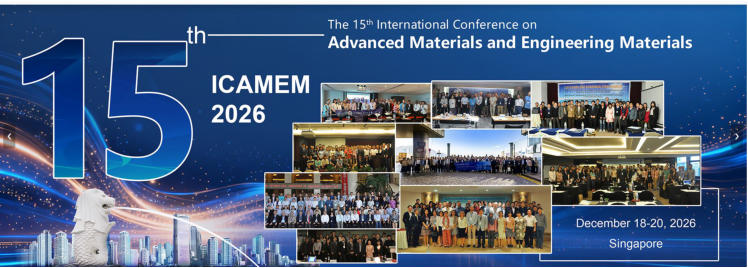
18-20 December, 2026 15th International Conference
on Advanced Materials and Engineering Materials
(ICAMEM 2026)
https://www.icamem.org/index.html
Dr. Andrei Honciuc serves in the Program Committee
https://www.icamem.org/committee.html
Advanced Materials plays a vital role in our lives because of its uniqueness in properties and extended application in various industries. These are the
basis of modern science and technology and the heart of many technological developments that touch our lives and find applications such as electronic
materials for communication and information technology, biomaterials for better health care, sensors for intelligent environment, energy materials for
renewable energy and environment, light alloys for better transportation, materials for strategic applications and more. All those interested are invited to
contribute. Important Dates: Submission deadline:Sep.15, 2026 (AoE) , Acceptance Date: Oct 5, 2026, Registration Deadline: Oct 20, 2026, Conference
Date: Dec 18-20, 2026
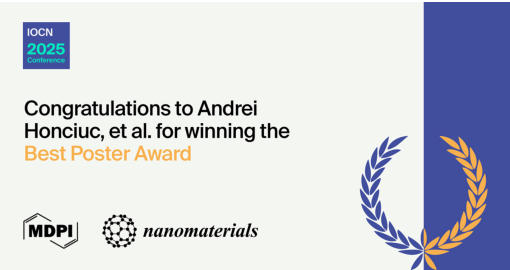
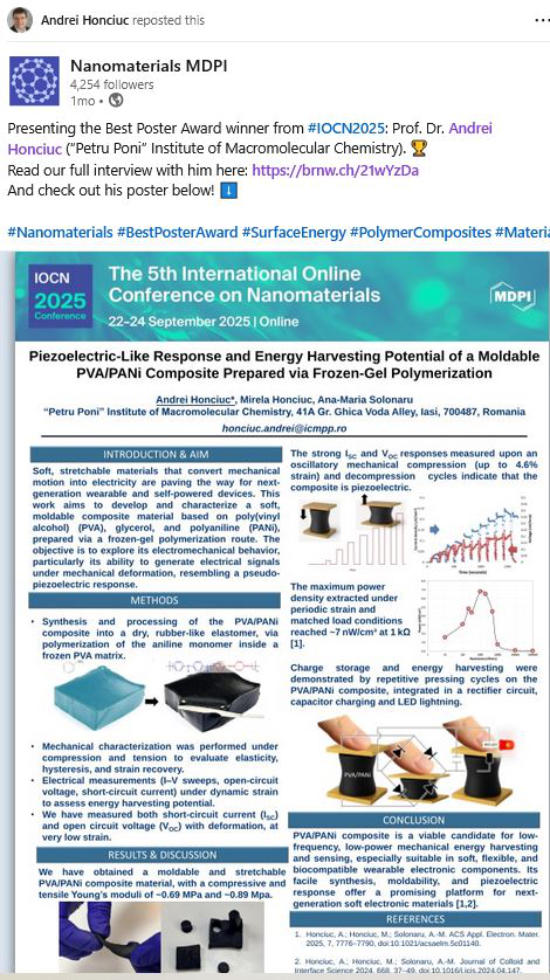
Dr. Andrei Honciuc, Dr. Mirela Honciuc and Dr. Ana-Maria Solonaru have won the The Best Poster Award for “Piezoelectric-Like Response and Energy
Harvesting Potential of a Moldable PVA/PANi Composite Prepared via Frozen-Gel Polymerization”, see the award page
https://sciforum.net/event/IOCN2025?subscribe§ion=#winnerannouncement
Interview with Andrei Honciuc—Winner of the IOCN 2025 Best Poster Award
23 December 2025 (Link to the interview)
We are pleased to share an interview with Prof. Dr. Andrei Honciuc, from “Petru Poni” Institute of
Macromolecular Chemistry, who received the Best Poster Award at the 5th International Online
Conference on Nanomaterials (IOCN 2025).
1. What inspired your interest in nanomaterials research, and how has your focus developed over
time?
My interest in nanomaterials grew out of a long-standing fascination with interfaces. Every
material phase is defined by its boundaries, and these boundaries behave unlike the bulk: they
carry excess energy (surface energy), they are chemically activated and are electronically active
and thus are the host for the most interesting physicochemical processes. The interface is the
“locus” for the heterogeneous catalysis, adsorption, adhesion, electron transfer, biological
recognition, and many other fundamental physicochemical phenomena. As I advanced in my
training, I became increasingly drawn to systems where interfacial effects dominate.
Nanomaterials offer precisely this environment: as the surface-to-volume ratio increases, the
interface becomes the controlling “engine” for the materials’ behavior. Studying nanomaterials
allowed me to explore how different phases communicate through charge, mass, and energy
exchange, and how new interfaces form when materials interact. Over time, this perspective has
shaped my research focus on colloidal systems, Pickering emulsions, polymer and hybrid
nanoparticles, and methods for probing surface energy and interfacial phenomena at the
nanoscale.
2. How does your current research contribute to advancing innovation or solving key challenges in
nanomaterials?
My research advances innovation in nanomaterials by creating systems whose interfacial
properties and morphology can be precisely engineered and directly linked to function. A central
theme is the control of surface architecture in Pickering-emulsion-derived polymer microspheres,
Janus nanoparticles, and hybrid composites, enabling materials with tunable properties such as
pollutant adsorption, encapsulation and controlled release of bioactives, colorimetric sensing,
variable conductivity, and piezoelectric response.
These efforts span several active directions: nanomaterials for environmental remediation,
nanostructured carriers for biomedical applications, and functional materials for optoelectronics
and energy harvesting.
An example is the work presented in the award-winning poster on polymer–nanoparticle
composites with piezoelectric response. By integrating conductive polymer nanoparticles into
polar, flexible polymer matrices, we design composites that convert mechanical deformation into
electrical output. Such materials address the need for lightweight, low-power energy harvesting
and sensing components.
3. When and how did you first become aware of the open access Nanomaterials journal? How do
you think open access impacts scholars like yourself?
I first became aware of the Nanomaterials journal while developing the NanoTRaPPED method, a
technique we introduced to quantitatively determine the surface energy of nanoparticles dispersed
in liquids. Surface energy is a central parameter governing nanoparticle stability, assembly, and
interfacial reactivity, yet it is notoriously difficult to measure directly at the nanoscale, on
nanoparticles. The NanoTRaPPED method provided a practical route to extract this quantity from
emulsification-polymerization experiments, and I chose Nanomaterials as the platform to publish
and promote this work to the broader community.
Open access played an essential role. For emerging ideas, prototype methodologies, and
unconventional directions, visibility is critical. Open access ensures that new concepts are
immediately available to researchers across disciplines and institutions, regardless of
subscription constraints. In my experience, this accelerates feedback, encourages adoption, and
creates the conditions for rapid refinement and follow-up studies.
My involvement with Nanomaterials continued beyond these initial publications. Later, I had the
opportunity to serve as Guest Editor for two editions of the Special Issue “Morphological Design
and Synthesis of Nanoparticles”. Both editions attracted strong interest and demonstrated the
value of open platforms in bringing together diverse perspectives on nanoparticle synthesis,
structure control, and interfacial behavior.
Overall, open access journals like Nanomaterials act as an effective launchpad for new ideas,
allowing early-stage concepts and frontier research to reach the community quickly and
transparently.
4. What message would you share with fellow early career researchers navigating similar paths?
I would encourage early career researchers to stay close to the fundamental questions that
genuinely motivate them. We owe it to ourselves to understand something of the inner workings of
this universe, and that pursuit often defines a fulfilled scientific and professional life. Strong
practical ideas will follow and these grow from careful observation, patient experimentation, and
the willingness to explore directions that may at first appear unconventional. Last but not least,
may you be inspired from nature; nature has done all the inventions for us already!
5. How do you see this award supporting your future work or goals?
This award enhances the visibility of my current research directions and helps position our work
more strongly within the nanomaterials community. This award creates momentum for advancing
our ideas, materials and the emerging technologies from our laboratory, such as NanoTRaPPED,
PEmPTech, water-floating composites for environmental remediation, and piezoelectric polymer
composites.
I also hope to attract researchers from the nanomaterials community interested in publishing their
work in our Special Issues:
“Morphological Design and Synthesis of Nanoparticles (Third Edition)” in Nanomaterials
“Emerging Topics in Polymeric Nanoparticles” in International Journal of Molecular Sciences